Rheims, where their presence aroused police suspicion that they were English spies, they visited Paris, meeting
Benjamin Franklin,
General Lafayette,
Marie Antoinette and
Louis XVI, and joined the French court at
Fontainebleau.
[34][35]
Pitt became Prime Minister in December 1783, with Wilberforce a key supporter of his
minority government.
[36] Despite their close friendship, there is no record that Pitt offered Wilberforce a
ministerial position in this or future governments. This may have been due to Wilberforce's wish to remain an independent MP. Alternatively, Wilberforce's frequent tardiness and disorganisation, as well as the chronic eye problems that at times made reading impossible, may have convinced Pitt that his trusted friend was not ministerial material. Wilberforce never sought office and was never offered one.
[37] When Parliament was dissolved in the spring of 1784, Wilberforce decided to stand as a candidate for the county of
Yorkshire in the
1784 general election.
[12] On 6 April, he was returned as MP for Yorkshire at the age of twenty-four.
[38]
Conversion[edit]
In October 1784, Wilberforce embarked upon a tour of Europe which would ultimately change his life and determine his future career. He travelled with his mother and sister in the company of
Isaac Milner, the brilliant younger brother of his former headmaster, who had been
Fellow of
Queens' College, Cambridge, in the year when Wilberforce first went up. They visited the
French Riviera and enjoyed the usual pastimes of dinners, cards, and gambling.
[39] In February 1785, Wilberforce returned to London temporarily, to support Pitt's proposals for parliamentary reforms. He rejoined the party in
Genoa, Italy, from where they continued their tour to Switzerland. Milner accompanied Wilberforce to England, and on the journey they read
The Rise and Progress of Religion in the Soul by
Philip Doddridge, a leading early 18th-century English
nonconformist.
[40]
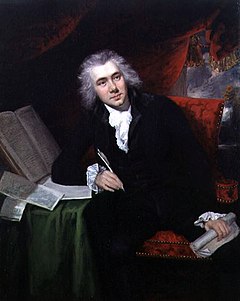
William Wilberforce by John Rising, 1790, pictured at the age of 29
During this time, Wilberforce explored afresh the spiritual principles he had first encountered in childhood through the influence of his aunt and the Methodists. He started to rise early to read the
Bible and pray and kept a private journal.
[41] He underwent an evangelical
conversion, regretting his past life and resolving to commit his future life and work to the service of God.
[12] His conversion changed some of his habits, but not his nature: he remained outwardly cheerful, interested and respectful, tactfully urging others towards his new faith.
[42] Inwardly, he underwent an agonising struggle and became relentlessly self-critical, harshly judging his spirituality, use of time,
vanity, self-control and relationships with others.
[43]
At the time, religious enthusiasm was generally regarded as a social transgression and was stigmatised in polite society. Evangelicals in the upper classes, such as
Sir Richard Hill, the Methodist MP for
Shropshire, and
Selina Hastings, Countess of Huntingdon, were exposed to contempt and ridicule,
[44] and Wilberforce's conversion led him to question whether he should remain in public life. He sought guidance from
John Newton, a leading
evangelical Anglican clergyman of the day and Rector of
St Mary Woolnoth in the
City of London.
[45][46] Both Newton and Pitt counselled him to remain in politics, and he resolved to do so "with increased diligence and conscientiousness".
[12] Thereafter, his political views were informed by his faith and by his desire to promote Christianity and Christian ethics in private and public life.
[47][48] His views were often deeply conservative, opposed to radical changes in a God-given political and social order, and focused on issues such as the
observance of the Sabbath and the eradication of immorality through education and reform.
[49] As a result, he was often distrusted by progressive voices because of his conservatism, and regarded with suspicion by many Tories who saw evangelicals as radicals, bent on the overthrow of church and state.
[28]
In 1786, Wilberforce leased a house in Old Palace Yard,
Westminster, in order to be near Parliament. He began using his parliamentary position to advocate reform by introducing a Registration Bill, proposing limited changes to parliamentary election procedures.
[12][50] He brought forward a bill to extend the measure permitting the
dissection after execution of criminals such as rapists, arsonists and thieves. The bill also advocated the reduction of sentences for women convicted of treason, a crime that at the time included a husband's murder. The
House of Commons passed both bills, but they were defeated in the
House of Lords.
[51][52]
Abolition of the slave trade[edit]
Initial decision[edit]
The British initially became involved in the slave trade during the 16th century. By 1783, the
triangular route that took British-made goods to Africa to buy slaves, transported the enslaved to the West Indies, and then brought slave-grown products such as sugar, tobacco, and cotton to Britain, represented about 80 percent of Great Britain's foreign income.
[53][54] British ships dominated the trade, supplying French, Spanish, Dutch, Portuguese and British colonies, and in peak years carried forty thousand enslaved men, women and children across the Atlantic in the horrific conditions of the
middle passage.
[55] Of the estimated 11 million Africans transported into slavery, about 1.4 million died during the voyage.
[56]
The British campaign to abolish the slave trade is generally considered to have begun in the 1780s with the establishment of the
Quakers' antislavery committees, and their presentation to Parliament of the first slave trade petition in 1783.
[57][58] The same year, Wilberforce, while dining with his old
Cambridge friend Gerard Edwards,
[59] met
Rev. James Ramsay, a
ship's surgeon who had become a clergyman on the island of St Christopher (later
St Kitts) in the
Leeward Islands, and a medical supervisor of the
plantations there. What Ramsay had witnessed of the conditions endured by the slaves, both at sea and on the plantations, horrified him. Returning to England after fifteen years, he accepted the
living of
Teston, Kent in 1781, and there met
Sir Charles Middleton, Lady Middleton,
Thomas Clarkson,
Hannah More and others, a group that later became known as the
Testonites.
[60] Interested in promoting Christianity and moral improvement in Britain and overseas, they were appalled by Ramsay's reports of the depraved lifestyles of slave owners, the cruel treatment meted out to the enslaved, and the lack of Christian instruction provided to the slaves.
[61] With their encouragement and help, Ramsay spent three years writing
An essay on the treatment and conversion of African slaves in the British sugar colonies, which was highly critical of slavery in the West Indies. The book, published in 1784, was to have an important impact in raising public awareness and interest, and it excited the ire of West Indian planters who in the coming years attacked both Ramsay and his ideas in a series of proslavery tracts.
[62]

Diagram of a slave ship, the
Brookes, illustrating the inhumane conditions aboard such vessels
Wilberforce apparently did not follow up on his meeting with Ramsay.
[59] However, three years later, and inspired by his new faith, Wilberforce was growing interested in
humanitarian reform. In November 1786, he received a letter from Sir Charles Middleton that re-opened his interest in the slave trade.
[63][64] At the urging of Lady Middleton, Sir Charles suggested that Wilberforce bring forward the abolition of the slave trade in Parliament. Wilberforce responded that he "felt the great importance of the subject, and thought himself unequal to the task allotted to him, but yet would not positively decline it".
[65] He began to read widely on the subject, and met with the
Testonites at Middleton's home at
Barham Court in Teston in the early winter of 1786–1787.
[66]
In early 1787, Thomas Clarkson, a fellow graduate of St John's, Cambridge, who had become convinced of the need to end the slave trade after writing a prize-winning essay on the subject while at Cambridge,
[60] called upon Wilberforce at Old Palace Yard with a published copy of the work.
[67][68] This was the first time the two men had met; their collaboration would last nearly fifty years.
[69][70] Clarkson began to visit Wilberforce on a weekly basis, bringing first-hand evidence
[71] he had obtained about the slave trade.
[69] The Quakers, already working for abolition, also recognised the need for influence within Parliament, and urged Clarkson to secure a commitment from Wilberforce to bring forward the case for abolition in the House of Commons.
[72][73]
It was arranged that Bennet Langton, a
Lincolnshire landowner and mutual acquaintance of Wilberforce and Clarkson, would organize a dinner party in order to ask Wilberforce formally to lead the parliamentary campaign.
[74] The dinner took place on 13 March 1787; other guests included Charles Middleton,
Sir Joshua Reynolds,
William Windham, MP, James Boswell and
Isaac Hawkins Browne, MP. By the end of the evening, Wilberforce had agreed in general terms that he would bring forward the abolition of the slave trade in Parliament, "provided that no person more proper could be found".
[75]
The same spring, on 12 May 1787, the still hesitant Wilberforce held a conversation with William Pitt and the future Prime Minister
William Grenville as they sat under a large oak tree on Pitt's estate in Kent.
[12] Under what came to be known as the "Wilberforce Oak" at
Holwood, Pitt challenged his friend: "Wilberforce, why don't you give notice of a motion on the subject of the Slave Trade? You have already taken great pains to collect evidence, and are therefore fully entitled to the credit which doing so will ensure you. Do not lose time, or the ground will be occupied by another."
[76] Wilberforce's response is not recorded, but he later declared in old age that he could "distinctly remember the very knoll on which I was sitting near Pitt and Grenville" where he made his decision.
[77]
Wilberforce's involvement in the abolition movement was motivated by a desire to put his Christian principles into action and to serve God in public life.
[78][79] He and other evangelicals were horrified by what they perceived was a depraved and un-Christian trade, and the greed and avarice of the owners and traders.
[79][80]Wilberforce sensed a call from God, writing in a journal entry in 1787 that "God Almighty has set before me two great objects, the suppression of the Slave Trade and the Reformation of Manners [moral values]".
[81][82] The conspicuous involvement of evangelicals in the highly popular anti-slavery movement served to improve the status of a group otherwise associated with the less popular campaigns against vice and immorality.
[83]
Early parliamentary action[edit]
On 22 May 1787, the first meeting of the
Society for Effecting the Abolition of the Slave Trade took place, bringing like-minded British Quakers and
Anglicans together in the same organisation for the first time.
[84] The committee chose to campaign against the slave trade rather than slavery itself, with many members believing that slavery would eventually disappear as a natural consequence of the abolition of the trade.
[85] Wilberforce, though involved informally, did not join the committee officially until 1791.
[86][87]
The society was highly successful in raising public awareness and support, and local chapters sprang up throughout Great Britain.
[57][88] Clarkson travelled the country researching and collecting first-hand testimony and statistics, while the committee promoted the campaign, pioneering techniques such as lobbying, writing pamphlets, holding public meetings, gaining press attention, organising boycotts and even using a campaign logo: an image of a kneeling slave above the motto "Am I not a Man and a Brother?", designed by the renowned pottery-maker
Josiah Wedgwood.
[57][89][90] The committee also sought to influence slave-trading nations such as France, Spain, Portugal, Denmark, Holland and the United States, corresponding with anti-slavery activists in other countries and organising the translation of English-language books and pamphlets.
[91] These included books by former slaves
Ottobah Cugoano and
Olaudah Equiano, who had published influential works on slavery and the slave trade in 1787 and
1789 respectively. They and other free blacks, collectively known as "Sons of Africa", spoke at debating societies and wrote spirited letters to newspapers, periodicals and prominent figures, as well as public letters of support to campaign allies.
[92][93][94]Hundreds of parliamentary petitions opposing the slave trade were received in 1788 and following years, with hundreds of thousands of signatories in total.
[57][90] The campaign proved to be the world's first grassroots
human rights campaign, in which men and women from different social classes and backgrounds volunteered to try to end the injustices suffered by others.
[95]
Wilberforce had planned to introduce a motion giving notice that he would bring forward a bill for the
Abolition of the Slave Tradeduring the 1789 parliamentary session. However, in January 1788, he was taken ill with a probable stress-related condition, now thought to be
ulcerative colitis.
[96][97] It was several months before he was able to resume work, and he spent time convalescing at
Bath and Cambridge. His regular bouts of gastrointestinal illnesses precipitated the use of moderate quantities of
opium, which proved effective in alleviating his condition,
[98] and which he continued to use for the rest of his life.
[99]
In Wilberforce's absence, Pitt, who had long been supportive of abolition, introduced the preparatory motion himself, and ordered a
Privy Council investigation into the slave trade, followed by a House of Commons review.
[100][101]
With the publication of the Privy Council report in April 1789 and following months of planning, Wilberforce commenced his parliamentary campaign.
[98][102] On 12 May 1789, he made his first major speech on the subject of abolition in the House of Commons, in which he reasoned that the trade was morally reprehensible and an issue of
natural justice. Drawing on Thomas Clarkson's mass of evidence, he described in detail the appalling conditions in which slaves travelled from Africa in the middle passage, and argued that abolishing the trade would also bring an improvement to the conditions of existing slaves in the
West Indies. He moved 12 resolutions condemning the slave trade, but made no reference to the abolition of slavery itself, instead dwelling on the potential for reproduction in the existing slave population should the trade be abolished.
[103][104] With the tide running against them, the opponents of abolition delayed the vote by proposing that the House of Commons hear its own evidence, and Wilberforce, in a move that has subsequently been criticised for prolonging the slave trade, reluctantly agreed.
[105][106] The hearings were not completed by the end of the
parliamentary session, and were deferred until the following year. In the meantime, Wilberforce and Clarkson tried unsuccessfully to take advantage of the egalitarian atmosphere of the
French Revolution to press for France's abolition of the trade,
[107] which was, in any event, to be abolished in 1794 as a result of the bloody slave revolt in
St. Domingue (later to be known as
Haiti), although later briefly restored by
Napoleon in 1802.
[108]
In January 1790, Wilberforce succeeded in speeding up the hearings by gaining approval for a smaller parliamentary
select committee to consider the vast quantity of evidence which had been accumulated.
[109] Wilberforce's house in Old Palace Yard became a centre for the abolitionists' campaign and a focus for many strategy meetings.
[12] Petitioners for other causes also besieged him there, and his ante-room was thronged from an early hour, like "Noah's Ark, full of beasts clean and unclean", according to Hannah More.
[31][110][111]
Let us not despair; it is a blessed cause, and success, ere long, will crown our exertions. Already we have gained one victory; we have obtained, for these poor creatures, the recognition of their human nature, which, for a while was most shamefully denied. This is the first fruits of our efforts; let us persevere and our triumph will be complete. Never, never will we desist till we have wiped away this scandal from the Christian name, released ourselves from the load of guilt, under which we at present labour, and extinguished every trace of this bloody traffic, of which our posterity, looking back to the history of these enlightened times, will scarce believe that it has been suffered to exist so long a disgrace and dishonour to this country.
William Wilberforce — speech before the House of Commons, 18 April 1791[112]
Interrupted by a general election in June 1790, the committee finally finished hearing witnesses, and in April 1791 with a closely reasoned four-hour speech, Wilberforce introduced the first
parliamentary billto abolish the slave trade.
[113][114] However, after two evenings of debate, the bill was easily defeated by 163 votes to 88, the political climate having swung in a conservative direction in the wake of the
French Revolution and in reaction to an increase in radicalism and to slave revolts in the
French West Indies.
[115][116] Such was the public hysteria of the time that even Wilberforce himself was suspected by some of being a
Jacobin agitator.
[117]
This was the beginning of a protracted parliamentary campaign, during which Wilberforce's commitment never wavered, despite frustration and hostility. He was supported in his work by fellow members of the so-called
Clapham Sect, among whom was his best friend and cousin
Henry Thornton.
[118][119] Holding evangelical Christian convictions, and consequently dubbed "the Saints", the group mainly lived in large houses surrounding the
common in
Clapham, then a village to the south-west of London. Wilberforce accepted an invitation to share a house with Henry Thornton in 1792, moving into his own home after Thornton's marriage in 1796.
[120] The "Saints" were an informal community, characterised by considerable intimacy as well as a commitment to practical Christianity and an opposition to slavery. They developed a relaxed family atmosphere, wandering freely in and out of each other's homes and gardens, and discussing the many religious, social and political topics that engaged them.
[121]
Pro-slavery advocates claimed that enslaved Africans were lesser human beings who benefited from their bondage.
[122] Wilberforce, the Clapham Sect and others were anxious to demonstrate that Africans, and particularly freed slaves, had human and economic abilities beyond the slave trade, and that they were capable of sustaining a well-ordered society, trade and cultivation. Inspired in part by the utopian vision of
Granville Sharp, they became involved in the establishment in 1792 of a free colony in
Sierra Leone with black settlers from Britain, Nova Scotia and Jamaica, as well as native Africans and some whites.
[122][123] They formed the
Sierra Leone Company, with Wilberforce subscribing liberally to the project in money and time.
[124] The dream was of an ideal society in which races would mix on equal terms; the reality was fraught with tension, crop failures, disease, death, war and defections to the slave trade. Initially a commercial venture, the British government assumed responsibility for the colony in 1808.
[122] The colony, although troubled at times, was to become a symbol of anti-slavery in which residents, communities and African tribal chiefs, worked together to prevent enslavement at the source, supported by a British
naval blockade to stem the region's slave trade.
[125][126]
On 2 April 1792, Wilberforce again brought a bill calling for abolition. The memorable debate that followed drew contributions from the greatest orators in the house,
William Pitt the Younger and
Charles James Fox, as well as from Wilberforce himself.
[127] Lord Melville, as
Home Secretary, proposed a compromise solution of so-called "gradual abolition" over a number of years. This was passed by 230 to 85 votes, but the compromise was little more than a clever ploy, with the intention of ensuring that total abolition would be delayed indefinitely.
[128]
War with France[edit]
On 26 February 1793, another vote to abolish the slave trade was narrowly defeated by eight votes. The outbreak of
war with France the same month effectively prevented any further serious consideration of the issue, as politicians concentrated on the national crisis and the threat of invasion.
[129] The same year, and again in 1794, Wilberforce unsuccessfully brought before Parliament a bill to outlaw British ships from supplying slaves to foreign colonies.
[122][130] He voiced his concern about the war and urged Pitt and his government to make greater efforts to end hostilities.
[131] Growing more alarmed, on 31 December 1794, Wilberforce moved that the government seek a peaceful resolution with France, a stance that created a temporary breach in his long friendship with Pitt.
[132]
Abolition continued to be associated in the public consciousness with the French Revolution and with British radical groups, resulting in a decline in public support.
[133]In 1795, the Society for Effecting the Abolition of the Slave Trade ceased to meet, and Clarkson retired in ill-health to the
Lake District.
[134][135] However, despite the decreased interest in abolition, Wilberforce continued to introduce abolition bills throughout the 1790s.
[136][137]
The early years of the 19th century once again saw an increased public interest in abolition. Since
Napoleon had reintroduced slavery in the French colonies, support of abolition was no longer perceived as being pro-French.
In 1804, Clarkson resumed his work and the Society for Effecting the Abolition of the Slave Trade began meeting again, strengthened with prominent new members such as
Zachary Macaulay,
Henry Brougham and
James Stephen.
[134][138] In June 1804, Wilberforce's bill to abolish the slave trade successfully passed all its stages through the House of Commons. However, it was too late in the parliamentary session for it to complete its passage through the House of Lords. On its reintroduction during the 1805 session, it was defeated, with even the usually sympathetic Pitt failing to support it.
[139] On this occasion and throughout the campaign, abolition was held back by Wilberforce's trusting, even credulous nature, and his deferential attitude towards those in power. He found it difficult to believe that men of rank would not do what he perceived to be the right thing, and was reluctant to confront them when they did not.
[137]
Final phase of the campaign[edit]
Following Pitt's death in January 1806, Wilberforce began to collaborate more with the
Whigs, especially the abolitionists. He gave general support to the
Grenville–Fox administration, which brought more abolitionists into the cabinet; Wilberforce and Charles Fox led the campaign in the House of Commons, while
Lord Grenvilleadvocated the cause in the House of Lords.
[122][140]
A radical change of tactics, which involved the introduction of a bill to ban British subjects from aiding or participating in the slave trade to the
French colonies, was suggested by maritime lawyer
James Stephen.
[141] It was a shrewd move, since the majority of British ships were now flying American flags and supplying slaves to foreign colonies with whom Britain was at war.
[142] A bill was introduced and approved by the cabinet, and Wilberforce and other abolitionists maintained a self-imposed silence, so as not to draw any attention to the effect of the bill.
[143][144] The approach proved successful, and the new Foreign Slave Trade Bill was quickly passed, and received
royal assent on 23 May 1806.
[145] Wilberforce and Clarkson had collected a large volume of evidence against the slave trade over the previous two decades, and Wilberforce spent the latter part of 1806 writing
A Letter on the Abolition of the Slave Trade, which was a comprehensive restatement of the abolitionists' case. The death of Fox in September 1806 was a blow, but was followed quickly by a
general election in the autumn of 1806.
[146] Slavery became an election issue, bringing more abolitionist MPs into the House of Commons, including former military men who had personally experienced the horrors of slavery and slave revolts.
[147] Wilberforce was re-elected as an MP for Yorkshire,
[148] after which he returned to finishing and publishing his
Letter, in reality a 400-page book which formed the basis for the final phase of the campaign.
[149]
Lord Grenville, the Prime Minister, was determined to introduce an Abolition Bill in the House of Lords, rather than in the House of Commons, taking it through its greatest challenge first.
[148] When a final vote was taken, the bill was passed in the House of Lords by a large margin.
[150] Sensing a breakthrough that had been long anticipated,
Charles Grey moved for a second reading in the Commons on 23 February 1807. As tributes were made to Wilberforce, whose face streamed with tears, the bill was carried by 283 votes to 16.
[145][151] Excited supporters suggested taking advantage of the large majority to seek the abolition of slavery itself, but Wilberforce made it clear that total emancipation was not the immediate goal: "They had for the present no object immediately before them, but that of putting stop directly to the carrying of men in British ships to be sold as slaves."
[152] The
Slave Trade Act received royal assent on 25 March 1807.
[153]
Personal life[edit]
In his youth, William Wilberforce showed little interest in women, but when he was in his late thirties his friend
Thomas Babington recommended twenty-year-old
Barbara Ann Spooner (1777–1847) as a potential bride.
[154] Wilberforce met her two days later on 15 April 1797, and was immediately smitten;
[12] following an eight-day whirlwind romance, he proposed.
[155] Despite the urgings of friends to slow down, the couple married at the
Church of St Swithin in Bath, Somerset, on 30 May 1797.
[12] They were devoted to each other, and Barbara was very attentive and supportive to Wilberforce in his increasing ill health, though she showed little interest in his political activities.
[12] They had six children in fewer than ten years: William (b. 1798), Barbara (b. 1799), Elizabeth (b. 1801),
Robert Isaac Wilberforce (b. 1802),
Samuel Wilberforce (b. 1805) and
Henry William Wilberforce (b. 1807).
[12] Wilberforce was an indulgent and adoring father who revelled in his time at home and at play with his children.
[156]
Other concerns[edit]
Political and social reform[edit]
Wilberforce was deeply conservative when it came to challenges to the existing political and social order. He advocated change in society through Christianity and improvement in morals, education and religion, fearing and opposing radical causes and revolution.
[49] The radical writer
William Cobbett was among those who attacked what they saw as Wilberforce's hypocrisy in campaigning for better working conditions for slaves while British workers lived in terrible conditions at home.
[157]"Never have you done one single act, in favour of the labourers of this country", he wrote.
[158] Critics noted Wilberforce's support of the suspension of
habeas corpus in 1795 and his votes for Pitt's "Gagging Bills", which banned meetings of more than 50 people, allowing speakers to be arrested and imposing harsh penalties on those who attacked the constitution.
[159][160] Wilberforce was opposed to giving
workers' rights to organise into unions, in 1799 speaking in favour of the
Combination Act, which suppressed trade union activity throughout Britain, and calling unions "a general disease in our society".
[159][161] He also opposed an
enquiry into the 1819
Peterloo Massacre in which eleven protesters were killed at a political rally demanding reform.
[162] Concerned about "bad men who wished to produce anarchy and confusion", he approved of the government's
Six Acts, which further limited public meetings and
seditious writings.
[163][164] Wilberforce's actions led the essayist
William Hazlitt to condemn him as one "who preaches vital Christianity to untutored savages, and tolerates its worst abuses in civilised states."
[165]
Wilberforce's views of women and religion were also conservative. He disapproved of women anti-slavery activists such as
Elizabeth Heyrick, who organised women's abolitionist groups in the 1820s, protesting: "[F]or ladies to meet, to publish, to go from house to house stirring up petitions – these appear to me proceedings unsuited to the female character as delineated in Scripture."
[166][167] Wilberforce initially strongly opposed bills for
Catholic emancipation, which would have allowed Catholics to become MPs, hold public office and serve in the army,
[168] although by 1813, he had changed his views and spoke in favour of a similar bill.
[169]
More progressively, Wilberforce advocated legislation to improve the working conditions for chimney-sweeps and textile workers, engaged in
prison reform, and supported campaigns to restrict
capital punishment and the severe punishments meted out under the Game Laws.
[170] He recognised the importance of education in alleviating poverty, and when Hannah More and her sister established
Sunday schools for the poor in
Somerset and the
Mendips, he provided financial and moral support as they faced opposition from landowners and Anglican clergy.
[171][172] From the late 1780s onward, Wilberforce campaigned for limited parliamentary reform, such as the abolition of
rotten boroughs and the redistribution of Commons seats to growing towns and cities, though by 1832, he feared that such measures went too far.
[159][173] With others, Wilberforce founded the world's first animal welfare organisation, the Society for the Prevention of Cruelty to Animals (later the
Royal Society for the Prevention of Cruelty to Animals).
[174] In 1824, Wilberforce was one of over 30 eminent gentlemen who put their names at the inaugural public meeting to the fledgling National Institution for the Preservation of Life from Shipwreck,
[175]later named the
Royal National Lifeboat Institution. He was also opposed to
duelling, which he described as the "disgrace of a Christian society" and was appalled when his friend Pitt engaged in a duel in 1798, particularly as it occurred on a Sunday, the Christian day of rest.
[176][177]
Wilberforce was generous with his time and money, believing that those with wealth had a duty to give a significant portion of their income to the needy. Yearly, he gave away thousands of pounds, much of it to clergymen to distribute in their parishes. He paid off the debts of others, supported education and
missions, and in a year of food shortages, gave to charity more than his own yearly income. He was exceptionally hospitable, and could not bear to sack any of his servants. As a result, his home was full of old and incompetent servants kept on in charity. Although he was often months behind in his correspondence, Wilberforce responded to numerous requests for advice or for help in obtaining professorships, military promotions and livings for clergymen, or for the reprieve of death sentences.
[178][179]
Evangelical Christianity[edit]
A supporter of the evangelical wing of the Church of England, Wilberforce believed that the revitalisation of the Church and individual Christian observance would lead to a harmonious, moral society.
[159] He sought to elevate the status of religion in public and private life, making piety fashionable in both the upper- and middle-classes of society.
[180] To this end, in April 1797, Wilberforce published
A Practical View of the Prevailing Religious System of Professed Christians in the Higher and Middle Classes of This Country Contrasted With Real Christianity, on which he had been working since 1793. This was an exposition of
New Testament doctrine and teachings and a call for a revival of Christianity, as a response to the moral decline of the nation, illustrating his own personal testimony and the views which inspired him. The book proved to be influential and a best-seller by the standards of the day; 7,500 copies were sold within six months, and it was translated into several languages.
[181][182]
Wilberforce fostered and supported missionary activity in Britain and abroad. He was a founding member of the
Church Missionary Society (since renamed the Church Mission Society) and was involved, with other members of the
Clapham Sect, in numerous other evangelical and charitable organisations.
[183][184] Horrified by the lack of Christian evangelism in India, Wilberforce used the 1793 renewal of the
British East India Company's charter to propose the addition of clauses requiring the company to provide teachers and chaplains and to commit to the "religious improvement" of Indians. The plan was unsuccessful due to lobbying by the directors of the company, who feared that their commercial interests would be damaged.
[185][186] Wilberforce tried again in 1813, when the charter next came up for renewal. Using petitions, meetings, lobbying and letter writing, he successfully campaigned for changes to the charter.
[159][187] Speaking in favour of the
Charter Act 1813, he criticised the
British in India for their hypocrisy and racial prejudice, while also condemning aspects of
Hinduism including the
caste system,
infanticide,
polygamy and
suttee. "Our religion is sublime, pure beneficent", he said, "theirs is mean, licentious and cruel".
[187][188]
Moral reform[edit]
Greatly concerned by what he perceived to be the degeneracy of British society, Wilberforce was also active in matters of moral reform, lobbying against "the torrent of profaneness that every day makes more rapid advances", and considered this issue and the abolition of the slave trade as equally important goals.
[189] At the suggestion of Wilberforce and
Bishop Porteus,
King George III was requested by the
Archbishop of Canterbury to issue in 1787 the
Proclamation for the Discouragement of Vice, as a remedy for the rising tide of immorality.
[190][191] The proclamation commanded the prosecution of those guilty of "excessive drinking, blasphemy, profane swearing and cursing, lewdness,
profanation of the Lord's Day, and other dissolute, immoral, or disorderly practices".
[192] Greeted largely with public indifference, Wilberforce sought to increase its impact by mobilising public figures to the cause,
[193] and by founding the
Society for the Suppression of Vice.
[193][194] This and other societies in which Wilberforce was a prime mover, such as the Proclamation Society, mustered support for the prosecution of those who had been charged with violating relevant laws, including brothel keepers, distributors of pornographic material, and those who did not respect the Sabbath.
[159] Years later, the writer and clergyman
Sydney Smith criticised Wilberforce for being more interested in the sins of the poor than those of the rich, and suggested that a better name would have been the Society for "suppressing the vices of persons whose income does not exceed £500 per annum".
[64][195] The societies were not highly successful in terms of membership and support, although their activities did lead to the imprisonment of Thomas Williams, the London printer of
Thomas Paine's
The Age of Reason.
[83][136] Wilberforce's attempts to legislate against adultery and Sunday newspapers were also in vain; his involvement and leadership in other, less punitive, approaches were more successful in the long-term, however. By the end of his life, British morals, manners, and sense of social responsibility had increased, paving the way for future changes in societal conventions and attitudes during the Victorian era.
[12][159][196]
Emancipation of enslaved Africans[edit]
The hopes of the abolitionists notwithstanding, slavery did not wither with the end of the slave trade in the
British Empire, nor did the living conditions of the enslaved improve. The trade continued, with few countries following suit by abolishing the trade, and with some British ships disregarding the legislation. Wilberforce worked with the members of the
African Institution to ensure the enforcement of abolition and to promote abolitionist negotiations with other countries.
[159][197][198] In particular, the US had abolished the slave trade in 1808, and Wilberforce lobbied the American government to enforce its own prohibition more strongly.
[199]
The same year, Wilberforce moved his family from Clapham to a sizeable mansion with a large garden in
Kensington Gore, closer to the Houses of Parliament. Never strong, and by 1812 in worsening health, Wilberforce
resigned his Yorkshire seat, and became MP for the
rotten borough of
Bramber in
Sussex, a seat with little or no constituency obligations, thus allowing him more time for his family and the causes that interested him.
[200] From 1816 Wilberforce introduced a series of bills which would require the compulsory registration of slaves, together with details of their country of origin, permitting the illegal importation of foreign slaves to be detected. Later in the same year he began publicly to denounce slavery itself, though he did not demand immediate emancipation, as "They had always thought the slaves incapable of liberty at present, but hoped that by degrees a change might take place as the natural result of the abolition."
[201]
In 1820, after a period of poor health, and with his eyesight failing, Wilberforce took the decision to further limit his public activities,
[202] although he became embroiled in unsuccessful mediation attempts between
King George IV, and his estranged wife
Caroline of Brunswick, who had sought her rights as queen.
[12] Nevertheless, Wilberforce still hoped "to lay a foundation for some future measures for the emancipation of the poor slaves", which he believed should come about gradually in stages.
[203] Aware that the cause would need younger men to continue the work, in 1821 he asked fellow MP
Thomas Fowell Buxton to take over leadership of the campaign in the Commons.
[202] As the 1820s wore on, Wilberforce increasingly became a figurehead for the abolitionist movement, although he continued to appear at anti-slavery meetings, welcoming visitors, and maintaining a busy correspondence on the subject.
[204][205][206]
The year 1823 saw the founding of the Society for the Mitigation and Gradual Abolition of Slavery (later the
Anti-Slavery Society),
[207] and the publication of Wilberforce's 56-page
Appeal to the Religion, Justice and Humanity of the Inhabitants of the British Empire in Behalf of the Negro Slaves in the West Indies.
[208] In his treatise, Wilberforce urged that total emancipation was morally and ethically required, and that slavery was a national crime that must be ended by parliamentary legislation to gradually abolish slavery.
[209] Members of Parliament did not quickly agree, and government opposition in March 1823 stymied Wilberforce's call for abolition.
[210] On 15 May 1823, Buxton moved another resolution in Parliament for gradual emancipation.
[211] Subsequent debates followed on 16 March and 11 June 1824 in which Wilberforce made his last speeches in the Commons, and which again saw the emancipationists outmanoeuvred by the government.
[212][213]
Last years[edit]
Wilberforce's health was continuing to fail, and he suffered further illnesses in 1824 and 1825. With his family concerned that his life was endangered, he declined a
peerage[214] and resigned his seat in Parliament, leaving the campaign in the hands of others.
[174][215] Thomas Clarkson continued to travel, visiting anti-slavery groups throughout Britain, motivating activists and acting as an ambassador for the anti-slavery cause to other countries,
[67] while Buxton pursued the cause of reform in Parliament.
[216] Public meetings and petitions demanding emancipation continued, with an increasing number supporting immediate abolition rather than the gradual approach favoured by Wilberforce, Clarkson and their colleagues.
[217][218]
In 1826, Wilberforce moved from his large house in Kensington Gore to Highwood Hill, a more modest property in the countryside of
Mill Hill, north of London,
[174] where he was soon joined by his son William and family. William had attempted a series of educational and career paths, and a venture into farming in 1830 led to huge losses, which his father repaid in full, despite offers from others to assist. This left Wilberforce with little income, and he was obliged to let his home and spend the rest of his life visiting family members and friends.
[219] He continued his support for the anti-slavery cause, including attending and chairing meetings of the Anti-Slavery Society.
[220]
Wilberforce approved of the 1830 election victory of the more progressive Whigs, though he was concerned about the implications of their Reform Bill which proposed the redistribution of parliamentary seats towards newer towns and cities and an extension of the franchise. In the event, the
Reform Act 1832 was to bring more abolitionist MPs into Parliament as a result of intense and increasing public agitation against slavery. In addition, the
1832 slave revolt in Jamaica convinced government ministers that abolition was essential to avoid further rebellion.
[221] In 1833, Wilberforce's health declined further and he suffered a severe attack of
influenza from which he never fully recovered.
[12] He made a final anti-slavery speech in April 1833 at a public meeting in
Maidstone, Kent.
[222] The following month, the Whig government introduced the
Bill for the Abolition of Slavery, formally saluting Wilberforce in the process.
[223] On 26 July 1833, Wilberforce heard of government concessions that guaranteed the passing of the Bill for the Abolition of Slavery.
[224] The following day he grew much weaker, and he died early on the morning of 29 July at his cousin's house in
Cadogan Place, London.
[225][226]
One month later, the House of Lords passed the
Slavery Abolition Act, which abolished slavery in most of the British Empire from August 1834.
[227] They voted plantation owners £20 million in compensation, giving full emancipation to children younger than six, and instituting a system of
apprenticeship requiring other enslaved peoples to work for their former masters for four to six years in the British West Indies, South Africa, Mauritius, British Honduras and Canada. Nearly 800,000 African slaves were freed, the vast majority in the Caribbean.
[228][229]
Funeral[edit]
While tributes were paid and Wilberforce was laid to rest, both Houses of Parliament suspended their business as a mark of respect.
[234]
Five years after his death, sons Robert and Samuel Wilberforce published a five-volume biography about their father, and subsequently a collection of his letters in 1840. The biography was controversial in that the authors emphasised Wilberforce's role in the abolition movement and played down the important work of
Thomas Clarkson. Incensed, Clarkson came out of retirement to write a book refuting their version of events, and the sons eventually made a half-hearted private apology to him and removed the offending passages in a revision of their biography.
[235][236][237] However, for more than a century, Wilberforce's role in the campaign dominated the history books. Later historians have noted the warm and highly productive relationship between Clarkson and Wilberforce, and have termed it one of history's great partnerships: without both the parliamentary leadership supplied by Wilberforce and the research and public mobilisation organised by Clarkson, abolition could not have been achieved.
[67][238][239]
As his sons had desired and planned, Wilberforce has long been viewed as a Christian hero, a statesman-saint held up as a role model for putting his faith into action.
[12][240][241] More broadly, he has also been described as a
humanitarian reformer who contributed significantly to reshaping the political and social attitudes of the time by promoting concepts of
social responsibility and action.
[159] In the 1940s, the role of Wilberforce and the Clapham Sect in abolition was downplayed by historian
Eric Williams, who argued that abolition was motivated not by humanitarianism but by economics, as the West Indian sugar industry was in decline.
[57][242] Williams' approach strongly influenced historians for much of the latter part of the 20th century. However, more recent historians have noted that the sugar industry was still making large profits at the time of abolition, and this has led to a renewed interest in Wilberforce and the Evangelicals, as well as a recognition of the anti-slavery movement as a prototype for subsequent humanitarian campaigns.
[57][243]
Memorials[edit]
Wilberforce's life and work have been widely commemorated. In Westminster Abbey, a seated statue of Wilberforce by
Samuel Josephwas erected in 1840, bearing an epitaph praising his Christian character and his long labour to abolish the slave trade and slavery itself.
[244]
In Wilberforce's home town of Hull, a public subscription in 1834 funded the Wilberforce Monument, a 31-metre (102 ft)
Greek Doric column topped by a statue of Wilberforce, which now stands in the grounds of
Hull College near
Queen's Gardens.
[245] Wilberforce's birthplace was acquired by the city corporation in 1903 and, following renovation,
Wilberforce House in Hull was opened as Britain's first slavery museum.
[246] Wilberforce Memorial School for the Blind in York was established in 1833 in his honour,
[247] and in 2006 the
University of Hull established the Wilberforce Institute for the study of Slavery and Emancipation in
Oriel Chambers, a building adjoining Wilberforce's birthplace.
[248] Various churches within the
Anglican Communion commemorate Wilberforce in their liturgical calendars,
[249] and
Wilberforce University in
Ohio, United States, founded in 1856, is named after him. The university was the first owned by
African-American people, and is a
historically black college.
[250][251] In
Ontario, Canada,
Wilberforce Colony was founded by black reformers, and inhabited by free slaves from the United States.
[252] The Wilberforce Society is a student think tank at the University of Cambridge. The town of
Wilberforce, New South Wales, Australia is named after him.
In popular culture[edit]
Bibliography[edit]
- Wilberforce, William (1797), A Practical View of the Prevailing Religious System of Professed Christians, in the Middle and Higher Classes in this Country, Contrasted with Real Christianity, London: T. Caddell
- Wilberforce, William (1807), A Letter on the Abolition of the Slave Trade, Addressed to the Freeholders of Yorkshire, London: T. Cadell and W. Davies, J. Hatchard
- Wilberforce, William (1823), An Appeal to the Religion, Justice, and Humanity of the Inhabitants of the British Empire in behalf of the Negro slaves in the West Indies, London: J. Hatchard and Son
See also[edit]
- Jump up^ Pollock 1977, p. 6
- Jump up^ Stott 2012, p. 16
- ^ Jump up to:a b c Hague 2007, p. 20
- Jump up^ Stott 2012, pp. xiii, 334
- Jump up^ Belmonte 2002, p. 8
- Jump up^ Lead, cotton, tools and cutlery were among the more frequent exports from Hull to the Baltic countries, with timber, iron ore, yarns, hemp, wine and manufactured goods being imported to Britain on the return journey. Hague 2007, p. 3
- Jump up^ Pollock 1977, p. 3
- Jump up^ Tomkins 2007, p. 9
- Jump up^ Pollock 1977, p. 4
- Jump up^ Hague 2007, p. 5
- Jump up^ Hague 2007, pp. 6–8
- ^ Jump up to:a b c d e f g h i j k l m n o p q r Wolffe, John; Harrison, B. (May 2006) [online edition; first published September 2004], "Wilberforce, William (1759–1833)", Oxford Dictionary of National Biography, Oxford University Press, doi:10.1093/ref:odnb/29386, ISBN 978-0-19-861411-1
- Jump up^ Hague 2007, pp. 14–15
- Jump up^ Pollock 1977, pp. 5–6
- Jump up^ Hague 2007, p. 15
- Jump up^ Hague 2007, pp. 18–19
- ^ Jump up to:a b Pollock 1977, p. 7
- Jump up^ Pollock 1977, pp. 8–9
- ^ Jump up to:a b Hague 2007, p. 23
- Jump up^ Hague, William (2004), William Pitt the Younger, London: HarperPerennial, p. 29, ISBN 978-1-58134-875-0
- ^ Jump up to:a b Pollock 1977, p. 9
- Jump up^ "Wilberforce, William (WLBR776W)". A Cambridge Alumni Database. University of Cambridge.
- Jump up^ Hague 2007, pp. 24–25
- Jump up^ Pollock 1977, p. 11
- Jump up^ Hochschild 2005, p. 125
- Jump up^ Hague 2007, p. 36
- Jump up^ Hague 2007, p. 359
- ^ Jump up to:a b Oldfield 2007, p. 44
- Jump up^ Hochschild 2005, pp. 125–26
- Jump up^ Pollock 1977, p. 15
- ^ Jump up to:a b Wilberforce, Robert Isaac; Wilberforce, Samuel (1838), The Life of William Wilberforce, John Murray
- Jump up^ "Sickly shrimp of a man who sank the slave ships", The Sunday Times, London: The Times, 25 March 2005, retrieved 27 November 2007
- Jump up^ Hague 2007, pp. 44–52
- ^ Jump up to:a b Hague 2007, pp. 53–55
- Jump up^ Pollock 1977, p. 23
- Jump up^ Pollock 1977, pp. 23–24
- Jump up^ Hague 2007, pp. 52–53, 59
- Jump up^ Pollock 1977, p. 31
- Jump up^ Hague 2007, pp. 70–72
- Jump up^ Hague 2007, pp. 72–74
- Jump up^ Pollock 1977, p. 37
- Jump up^ Hague 2007, pp. 99–102
- Jump up^ Hague 2007, pp. 207–10
- Jump up^ Brown 2006, pp. 380–82
- Jump up^ Pollock 1977, p. 38
- Jump up^ Brown 2006, p. 383
- Jump up^ Brown 2006, p. 386
- Jump up^ Bradley, Ian (1985), "Wilberforce the Saint", in Jack Hayward, Out of Slavery: Abolition and After, Frank Cass, pp. 79–81, ISBN 978-0-7146-3260-5
- ^ Jump up to:a b Hague 2007, p. 446
- Jump up^ Hague 2007, p. 97
- Jump up^ Hague 2007, pp. 97–99
- Jump up^ Pollock 1977, pp. 40–42
- Jump up^ Hague 2007, pp. 116, 119
- Jump up^ D'Anjou 1996, p. 97
- Jump up^ Hochschild 2005, pp. 14–15
- Jump up^ Hochschild 2005, p. 32
- ^ Jump up to:a b c d e f Pinfold, John (2007), "Introduction", in Bodleian Library (Ed.), The Slave Trade Debate: Contemporary Writings For and Against, Bodleian Library, University of Oxford, ISBN 978-1-85124-316-7
- Jump up^ Ackerson 2005, p. 9
- ^ Jump up to:a b Pollock 1977, p. 17
- ^ Jump up to:a b Hague 2007, pp. 138–39
- Jump up^ Brown 2006, pp. 351–52, 362–63
- Jump up^ Brown 2006, pp. 364–66
- Jump up^ Pollock 1977, p. 48
- ^ Jump up to:a b Tomkins 2007, p. 55
- Jump up^ Hague 2007, p. 140
- Jump up^ Pollock 1977, p. 53
- ^ Jump up to:a b c Brogan, Hugh; Harrison, B. (October 2007) [online edition; first published September 2004], "Clarkson, Thomas (1760–1846)", Oxford Dictionary of National Biography, Oxford University Press, doi:10.1093/ref:odnb/5545, ISBN 978-0-19-861411-1
- Jump up^ Metaxas, Eric (2007), Amazing Grace: William Wilberforce and the Heroic Campaign to End Slavery, New York: HarperSanFrancisco, p. 111, ISBN 978-0-06-128787-9
- ^ Jump up to:a b Pollock 1977, p. 55
- Jump up^ Hochschild 2005, pp. 123–24
- Jump up^ Clarkson, Thomas (1836), The History of the Rise, Progress and Accomplishment of the Abolition of the African Slave-Trade, Online – Project Gutenberg
- Jump up^ Hochschild 2005, p. 122
- Jump up^ D'Anjou 1996, pp. 157–158
- Jump up^ Pollock 1977, p. 56
- Jump up^ Hochschild 2005, pp. 122–124
- Jump up^ Tomkins 2007, p. 57
- Jump up^ Pollock 1977, p. 58 quoting Harford, p. 139
- Jump up^ Brown 2006, pp. 26, 341, 458–459
- ^ Jump up to:a b Hague 2007, pp. 143, 119
- Jump up^ Pinfold 2007, pp. 10, 13
- Jump up^ Pollock 1977, p. 69
- Jump up^ Piper, John (2006), Amazing Grace in the Life of William Wilberforce, Wheaton, Illinois: Crossway Books, p. 35, ISBN 978-1-58134-875-0
- ^ Jump up to:a b Brown 2006, pp. 386–387
- Jump up^ Ackerson 2005, pp. 10–11
- Jump up^ Ackerson 2005, p. 15
- Jump up^ Fogel, Robert William (1989), Without Consent Or Contract: The Rise and Fall of American Slavery, W. W. Norton & Company, p. 211, ISBN 978-0-393-31219-5
- Jump up^ Oldfield 2007, pp. 40–41
- Jump up^ Ackerson 2005, p. 11
- Jump up^ Hague 2007, pp. 149–151
- ^ Jump up to:a b Crawford, Neta C. (2002), Argument and Change in World Politics: Ethics, Decolonization, and Humanitarian Intervention, Cambridge University Press, p. 178, ISBN 0-521-00279-6
- Jump up^ Hochschild 2005, p. 127
- Jump up^ Hochschild 2005, pp. 136, 168
- Jump up^ Brown 2006, p. 296
- Jump up^ Fisch, Audrey A (2007), The Cambridge Companion to the African American Slave Narrative, Cambridge University Press, p. xv, ISBN 0-521-85019-3
- Jump up^ Hochschild 2005, pp. 5–6
- Jump up^ Pollock 1977, pp. 78–79
- Jump up^ Hague 2007, pp. 149–157
- ^ Jump up to:a b Hochschild 2005, p. 139
- Jump up^ Pollock 1977, pp. 79–81
- Jump up^ Pollock 1977, p. 82
- Jump up^ Hague 2007, p. 159
- Jump up^ D'Anjou 1996, p. 166
- Jump up^ Hague 2007, pp. 178–183
- Jump up^ Hochschild 2005, p. 160
- Jump up^ Hague 2007, pp. 185–186
- Jump up^ Hochschild 2005, pp. 161–162
- Jump up^ Hague 2007, pp. 187–189
- Jump up^ Hochschild 2005, pp. 256–267, 292–293
- Jump up^ Hague 2007, pp. 189–190
- Jump up^ Hochschild 2005, p. 188
- Jump up^ Hague 2007, pp. 201–202
- Jump up^ Hansard, T.C. (printer) (1817), The Parliamentary history of England from the earliest period to the year 1803, XXIX, London: Printed by T.C. Hansard, p. 278
- Jump up^ Hague 2007, p. 193
- Jump up^ Pollock 1977, pp. 105–108
- Jump up^ D'Anjou 1996, p. 167
- Jump up^ Hague 2007, pp. 196–198
- Jump up^ Walvin, James (2007), A Short History of Slavery, Penguin Books, p. 156, ISBN 978-0-14-102798-2
- Jump up^ Pollock 1977, p. 218
- Jump up^ D'Anjou 1996, p. 140
- Jump up^ Wolffe, John; Harrison, B.; Goldman, L. (May 2007), "Clapham Sect (act. 1792–1815)", Oxford Dictionary of National Biography, Oxford University Press, doi:10.1093/ref:odnb/42140, ISBN 978-0-19-861411-1
- Jump up^ Hague 2007, pp. 218–219
- ^ Jump up to:a b c d e Turner, Michael (April 1997), "The limits of abolition: Government, Saints and the 'African Question' c 1780–1820", The English Historical Review, Oxford University Press, 112 (446): 319–357, doi:10.1093/ehr/cxii.446.319, JSTOR 578180
- Jump up^ Hochschild 2005, p. 150
- Jump up^ Hague 2007, pp. 223–224
- Jump up^ Rashid, Ismail (2003), "A Devotion to the idea of liberty at any price: Rebellion and Antislavery in the Eighteenth and Nineteenth Century Upper Guinea Coast", in Sylviane Anna Diouf, Fighting the Slave Trade: West African Strategies, Ohio University Press, p. 135, ISBN 0-8214-1516-6
- Jump up^ Ackerson 2005, p. 220
- Jump up^ Pollock 1977, p. 114
- Jump up^ Pollock 1977, p. 115
- Jump up^ Pollock 1977, pp. 122–123
- Jump up^ Hague 2007, p. 242
- Jump up^ Pollock 1977, pp. 121–122
- Jump up^ Hague 2007, pp. 247–249
- Jump up^ Hague 2007, pp. 237–239
- ^ Jump up to:a b Ackerson 2005, p. 12
- Jump up^ Hague 2007, p. 243
- ^ Jump up to:a b Hochschild 2005, p. 252
- ^ Jump up to:a b Hague 2007, p. 511
- Jump up^ Hague 2007, p. 316
- Jump up^ Hague 2007, pp. 313–320
- Jump up^ Hague 2007, pp. 328–330
- Jump up^ Pollock 1977, p. 201
- Jump up^ Hague 2007, pp. 332–334
- Jump up^ Hague 2007, pp. 335–336
- Jump up^ Drescher, Seymour (Spring 1990), "People and Parliament: The Rhetoric of the British Slave Trade", Journal of Interdisciplinary History, MIT Press, 20 (4): 561–580, doi:10.2307/203999, JSTOR 203999
- ^ Jump up to:a b Pollock 1977, p. 211
- Jump up^ Hague 2007, pp. 342–344
- Jump up^ Hochschild 2005, pp. 304–306
- ^ Jump up to:a b Hague 2007, p. 348
- Jump up^ Hague 2007, p. 351
- Jump up^ Tomkins 2007, pp. 166–168
- Jump up^ Hague 2007, p. 354
- Jump up^ Hague 2007, p. 355
- Jump up^ Pollock 1977, p. 214
- Jump up^ Hochschild 2005, p. 251
- Jump up^ Pollock 1977, p. 157
- Jump up^ Hague 2007, pp. 294–295
- Jump up^ Hague 2007, pp. 440–441
- Jump up^ Cobbett, William (1823), Cobbett's Political Register, Cox and Baylis, p. 516
- ^ Jump up to:a b c d e f g h i Hind, Robert J. (1987), "William Wilberforce and the Perceptions of the British People", Historical Research, 60 (143): 321–335, doi:10.1111/j.1468-2281.1987.tb00500.x
- Jump up^ Hague 2007, pp. 250, 254–256
- Jump up^ Hague 2007, p. 286
- Jump up^ Hague 2007, pp. 441–442
- Jump up^ Hague 2007, p. 442
- Jump up^ Tomkins 2007, pp. 195–196
- Jump up^ Hazlitt, William (1825), The spirit of the age, London: C. Templeton, p. 185
- Jump up^ Hochschild 2005, pp. 324–327
- Jump up^ Hague 2007, p. 487
- Jump up^ Tomkins 2007, pp. 172–173
- Jump up^ Hague 2007, pp. 406–407
- Jump up^ Hague 2007, p. 447
- Jump up^ Pollock 1977, pp. 92–93
- Jump up^ Stott 2003, pp. 103–105, 246–447
- Jump up^ Hague 2007, pp. 74, 498
- ^ Jump up to:a b c Tomkins 2007, p. 207
- Jump up^ "RNLI Our History". RNLI. Retrieved 30 March 2016.
- Jump up^ Hague 2007, pp. 287–288
- Jump up^ Hochschild 2005, p. 299
- Jump up^ Hochschild 2005, p. 315
- Jump up^ Hague 2007, pp. 211–212, 295, 300
- Jump up^ Brown 2006, pp. 385–386
- Jump up^ Hague 2007, pp. 271–272, 276
- Jump up^ Pollock 1977, pp. 146–153
- Jump up^ Pollock 1977, p. 176
- Jump up^ Hague 2007, pp. 220–221
- Jump up^ Tomkins 2007, pp. 115–116
- Jump up^ Hague 2007, pp. 221, 408
- ^ Jump up to:a b Tomkins 2007, pp. 187–188
- Jump up^ Keay, John (2000), India: A History, New York: Grove Press, p. 428, ISBN 0-8021-3797-0
- Jump up^ Tomkins 2007, pp. 54–55
- Jump up^ Pollock 1977, p. 61
- Jump up^ Brown 2006, p. 346
- Jump up^ Hochschild 2005, p. 126
- ^ Jump up to:a b Hague 2007, p. 108
- Jump up^ Brown 2006, p. 385
- Jump up^ Hague 2007, p. 109
- Jump up^ Hague 2007, p. 514
- Jump up^ Tomkins 2007, pp. 182–183
- Jump up^ Ackerson 2005, pp. 142, 168, 209
- Jump up^ Hague 2007, pp. 393–394, 343
- Jump up^ Hague 2007, pp. 377–379, 401–406
- Jump up^ Hague 2007, pp. 415, 343
- ^ Jump up to:a b Pollock 1977, p. 279
- Jump up^ Hague 2007, p. 474
- Jump up^ Ackerson 2005, p. 181
- Jump up^ Oldfield 2007, p. 48
- Jump up^ Hague 2007, pp. 492–493, 498
- Jump up^ Pollock 1977, p. 286
- Jump up^ Pollock 1977, p. 285
- Jump up^ Hague 2007, pp. 477–479
- Jump up^ Hague 2007, p. 481
- Jump up^ Tomkins 2007, p. 203
- Jump up^ Pollock 1977, p. 289
- Jump up^ Hague 2007, p. 480
- Jump up^ According to George W. E. Russell, on the grounds that it would exclude his sons from intimacy with private gentlemen, clergymen and mercantile families, (1899), Collections & Recollections, revised edition, Elder Smith & Co, London, p. 77.
- Jump up^ Oldfield 2007, p. 45
- Jump up^ Blouet, Olwyn Mary; Harrison, B. (October 2007) [online edition; first published September 2004], "Buxton, Sir Thomas Fowell, first baronet (1786–1845)", Oxford Dictionary of National Biography, Oxford University Press, doi:10.1093/ref:odnb/4247, ISBN 978-0-19-861411-1
- Jump up^ Hague 2007, pp. 486–487
- Jump up^ Tomkins 2007, pp. 206–207
- Jump up^ Hague 2007, p. 494
- Jump up^ Tomkins 2007, p. 213
- Jump up^ Hague 2007, p. 498
- Jump up^ Tomkins 2007, p. 217
- Jump up^ Hague 2007, pp. 498–499
- Jump up^ Hague 2007, p. 502
- Jump up^ Pollock 1977, p. 308
- Jump up^ Hague 2007, pp. 502–503
- Jump up^ The legislation specifically excluded the territories of the Honourable East India Company which were not then under direct Crown control.
- Jump up^ Kerr-Ritchie, Jeffrey R. (2007), Rites of August First: Emancipation Day in the Black Atlantic World, LSU Press, pp. 16–17, ISBN 0-8071-3232-2
- Jump up^ Britain, Great; Evans, William David; Hammond, Anthony; Granger, Thomas Colpitts (1836), Slavery Abolition Act 1833, W. H. Bond
- Jump up^ Hague 2007, p. 304
- Jump up^ Hague 2007, p. 504
- Jump up^ Pollock 1977, pp. 308–309
- Jump up^ "Funeral of the Late Mr. Wilberforce", The Times (15235), pp. 3, col. C, 5 August 1833
- Jump up^ Hague, William. Wilberforce Address, Conservative Christian Fellowship(November 1998)
- Jump up^ Clarkson, Thomas (1838), Strictures on a Life of William Wilberforce, by the Rev. W. Wilberforce and the Rev. S. Wilberforce, London
- Jump up^ Ackerson 2005, pp. 36–37, 41
- Jump up^ Hochschild 2005, pp. 350–351
- Jump up^ Hague 2007, pp. 154–155, 509
- Jump up^ Hochschild 2005, pp. 351–352
- Jump up^ "William Wilberforce", The New York Times, 13 December 1880, retrieved 24 March 2008
- Jump up^ Oldfield 2007, pp. 48–49
- Jump up^ Williams, Eric (1944), Capitalism and Slavery, University of North Carolina Press, p. 211, ISBN 978-0-8078-4488-5
- Jump up^ D'Anjou 1996, p. 71
- Jump up^ William Wilberforce, Westminster Abbey, retrieved 21 March 2008
- Jump up^ The Wilberforce Monument, BBC, retrieved 21 March 2008
- Jump up^ Oldfield 2007, pp. 70–71
- Jump up^ Oldfield 2007, pp. 66–67
- Jump up^ "Centre for slavery research opens". BBC News. London: BBC. 6 July 2006. Retrieved 30 October 2011.
- Jump up^ Bradshaw, Paul (2002), The New SCM Dictionary of Liturgy and Worship, SCM-Canterbury Press Ltd, p. 420, ISBN 0-334-02883-3
- Jump up^ Ackerson 2005, p. 145
- Jump up^ Beauregard, Erving E. (2003), Wilberforce University in "Cradles of Conscience: Ohio's Independent Colleges and Universities" Eds. John William. Oliver Jr., James A. Hodges, and James H. O'Donnell, Kent State University Press, pp. 489–490, ISBN 978-0-87338-763-7
- Jump up^ Richard S. Newman (2008), Freedom's prophet: Bishop Richard Allen, the AME Church, and the Black founding fathers, NYU Press, p. 271, ISBN 978-0-8147-5826-7
- Jump up^ Langton, James; Hastings, Chris (25 February 2007), "Slave film turns Wilberforce into a US hero", Daily Telegraph, retrieved 16 April 2008
- Jump up^ Riding, Alan (14 February 2007), "Abolition of slavery is still an unfinished story", International Herald Tribune, retrieved 16 April 2008
References[edit]
- Ackerson, Wayne (2005), The African Institution (1807–1827) and the Antislavery Movement in Great Britain, Lewiston, New York: E. Mellen Press, ISBN 978-0-7734-6129-1, OCLC 58546501
- Bayne, Peter (1890), Men Worthy to Lead; Being Lives of John Howard, William Wilberforce, Thomas Chalmers, Thomas Arnold, Samuel Budgett, John Foster, London: Simpkin, Marshall, Hamilton, Kent & Co. Ltd, Reprinted by Bibliolife, ISBN 1-152-41551-4
- Belmonte, Kevin (2002), Hero for Humanity: A Biography of William Wilberforce, Colorado Springs, Colorado: Navpress Publishing Group, ISBN 978-1-57683-354-4, OCLC 49952624
- Brown, Christopher Leslie (2006), Moral Capital: Foundations of British Abolitionism, Chapel Hill: University of North Carolina Press, ISBN 978-0-8078-5698-7, OCLC 62290468
- Carey, Brycchan (2005), British Abolitionism and the Rhetoric of Sensibility: Writing, Sentiment, and Slavery, 1760–1807, Basingstoke: Palgrave Macmillan, ISBN 978-1-4039-4626-3, OCLC 58721077
- Coupland, Reginald. Wilberforce: A Narrative (1923) online
- D'Anjou, Leo (1996), Social Movements and Cultural Change: The First Abolition Campaign Revisited, New York: Aldine de Gruyter, ISBN 978-0-202-30522-6, OCLC 34151187
- Furneaux, Robin (2006) [1974], William Wilberforce, London: Hamish Hamilton, ISBN 978-1-57383-343-1, OCLC 1023912
- Hague, William (2007), William Wilberforce: The Life of the Great Anti-Slave Trade Campaigner, London: HarperPress, ISBN 978-0-00-722885-0, OCLC 80331607online free to borrow
- Hennell, Michael (1950), William Wilberforce, 1759–1833: the Liberator of the Slave, London: Church Book Room, OCLC 8824569
- Hochschild, Adam (2005), Bury the Chains, The British Struggle to Abolish Slavery, London: Macmillan, ISBN 978-0-330-48581-4, OCLC 60458010
- Metaxas, Eric (2007), Amazing Grace: William Wilberforce and the Heroic Campaign to End Slavery, New York: HarperSanFrancisco, ISBN 0-06-117300-2, OCLC 81967213
- Oldfield, John (2007), Chords of Freedom: Commemoration, Ritual and British Transatlantic Slavery, Manchester: Manchester University Press, ISBN 978-0-7190-6664-1, OCLC 132318401
- Pollock, John (1977), Wilberforce, New York: St. Martin's Press, ISBN 978-0-09-460780-4, OCLC 3738175
- Pura, Murray Andrew (2002), Vital Christianity: The Life and Spirituality of William Wilberforce, Toronto: Clements, ISBN 1-894667-10-7, OCLC 48242442
- Reed, Lawrence W. (2008). "Wilberforce, William (1759–1833)". In Hamowy, Ronald. The Encyclopedia of Libertarianism. Thousand Oaks, California: SAGE; Cato Institute. pp. 544–545. doi:10.4135/9781412965811.n330. ISBN 978-1-4129-6580-4. LCCN 2008009151. OCLC 750831024.
- Rodriguez, Junius (2007), Encyclopedia of Emancipation and Abolition in the Transatlantic World, Armonk, NY: M.E. Sharpe, ISBN 978-0-7656-1257-1, OCLC 75389907
- Stott, Anne (2003), Hannah More: The First Victorian, Oxford: Oxford University Press, ISBN 978-0-19-924532-1, OCLC 186342431
- Stott, Anne (2012), Wilberforce: Family and Friends, New York: Oxford University Press, ISBN 978-0-19-969939-1
- Tomkins, Stephen (2007), William Wilberforce – A Biography, Oxford: Lion, ISBN 978-0-09-460780-4, OCLC 72149062
- Vaughan, David J. (2002), Statesman and Saint: The Principled Politics of William Wilberforce, Nashville, Tennessee: Cumberland House, ISBN 978-1-58182-224-3, OCLC 50464553
- Walvin, James (2007), A Short History of Slavery, London: Penguin, ISBN 978-0-14-102798-2, OCLC 75713230
- Wilberforce, R. I; Wilberforce, S. (1838), The Life of William Wilberforce, London: John Murray, OCLC 4023508 online free
- Wolffe, John. "Wilberforce, William (1759–1833)" Oxford Dictionary of National Biography (2009) https://doi.org/10.1093/ref:odnb/29386
External links[edit]


 Definitions from Wiktionary
 Media from Wikimedia Commons
 News from Wikinews
 Quotations from Wikiquote
 Texts from Wikisource


.jpg)


